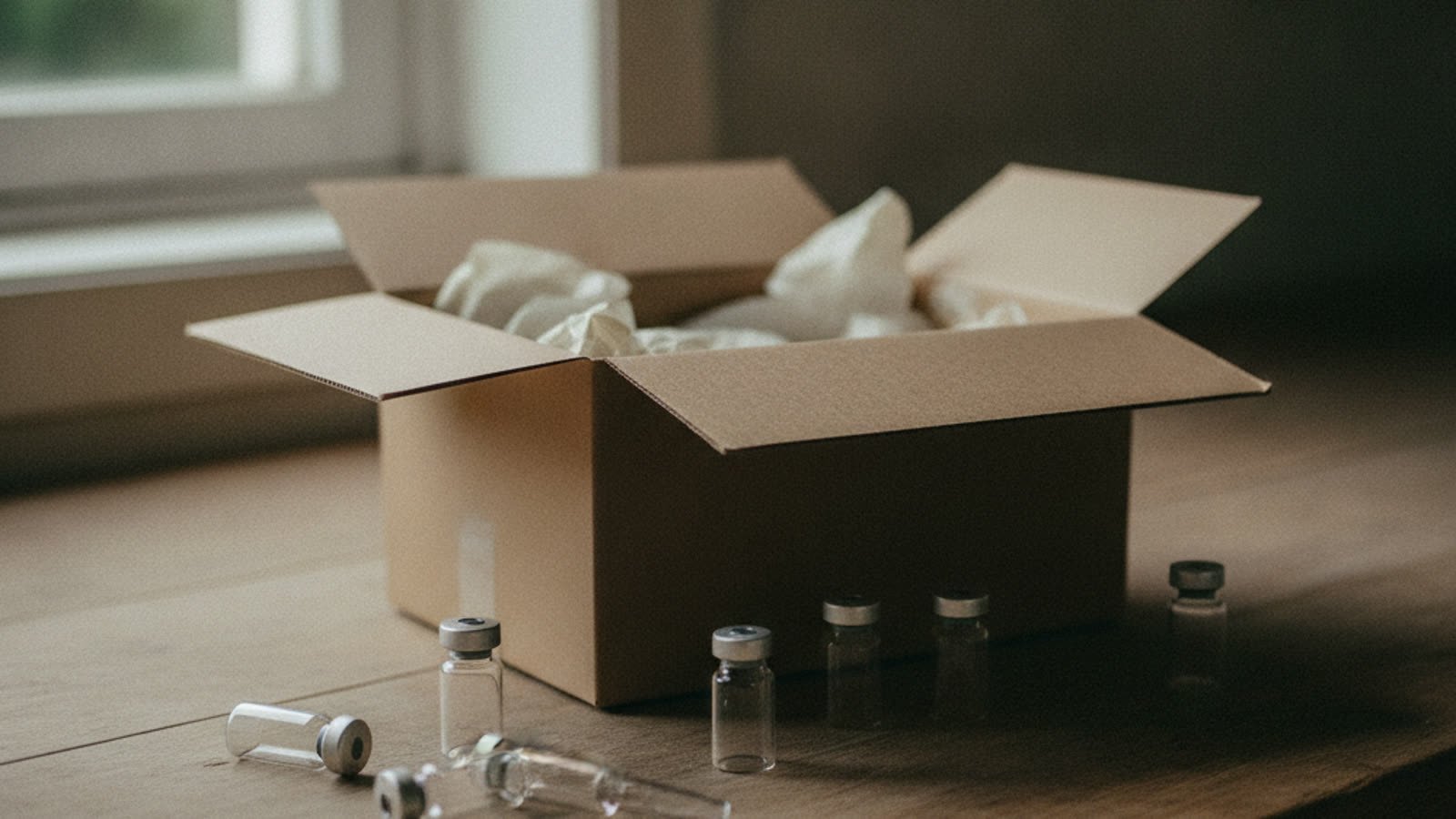
Are research peptides safe? Nobody can answer that for a given vial, and the reason is structural. The "research use only" label on BPC-157, TB-500 or grey-market semaglutide is borrowed from diagnostics regulation, gives an injectable drug no legal exemption, and marks the link in the supply chain where no regulator checks the batch before it ships.
Here is the argument of this piece. The peptide supply chain has five links, from the factory that synthesises the raw ingredient to the person holding the syringe. Regulators have built checkpoints at some of them, most visibly a border list for GLP-1 ingredients in September 2025. The research-use-only vial sits in the gap between those checkpoints, and it sits there by design. I think the label is best read not as a disclaimer but as a map of where oversight stops, and the evidence from actual test purchases supports that reading.
Nothing below is a suggestion to use, avoid or source any compound. It is a report on how the market is built, what published testing found and what the FDA has put in writing. The dated legal status of each compound is on the Ozemback peptide status tracker.
What does "research use only" actually mean on a peptide?
The phrase "For Research Use Only" has a precise home in US law, and that home is not drugs. Under 21 CFR 809.10(c)(2)(i), in vitro diagnostic products still in the research phase must carry the statement "For Research Use Only. Not for use in diagnostic procedures." Part 809 governs test kits and reagents used on samples in a laboratory, not substances injected into a person. No equivalent provision lets a seller turn an injectable peptide into an unregulated chemical by printing four words on the vial. Research peptide sellers borrowed the vocabulary of diagnostics regulation without the regulatory category that comes with it.
The FDA has said so in writing, repeatedly. In a warning letter dated 10 December 2024 to Summit Research Peptides of Hoover, Alabama, the agency addressed semaglutide, tirzepatide, retatrutide, cagrilintide and mazdutide labelled "RESEARCH USE ONLY" and concluded, from the company's own website claims, that they were drugs for human use, citing sections 505(a) and 301(d) of the Federal Food, Drug, and Cosmetic Act. The letter to USApeptide.com of 26 February 2025 and the letter to Peptide Partners LLC of 24 August 2026 reach the same conclusion in almost the same words. The label states what the seller wants a regulator to believe about intent; the FDA reads intent from everything else on the page.
Where do research peptides come from before they reach the vial?
Every research peptide vial passes through the same five links, whatever the molecule. A manufacturer synthesises the raw active ingredient. Someone fills, freeze-dries and labels it. A storefront sells it. The buyer sources a diluent and a syringe. Then a person injects it. The table below sets out what checks each link as of 26 September 2026, drawn only from FDA documents and the published studies cited on this page. The pattern is visible at a glance: oversight is concentrated at the border for one drug class, and reaches the storefront only after the product has shipped.
| Link in the chain | What happens there | What checks it (as of 26 Sep 2026) |
|---|---|---|
| 1. Raw ingredient | A manufacturer synthesises the active peptide in bulk | GLP-1s only: FDA Import Alert 66-80 green list since 5 Sep 2025. BPC-157, TB-500 and similar peptides are outside its scope. |
| 2. Fill and label | Powder is portioned into vials and labelled "research use only" | No pre-shipment batch check. The FDA treats the product as a drug once human use is evident. |
| 3. Storefront | A website sells the vial, usually without a prescription | FDA warning letters, after the fact: Dec 2024, Feb 2025, Aug 2026 among others. |
| 4. Diluent and syringe | Often bought separately from other retailers | No link to the vial or the seller. One FDA letter lists a "reconstitution solution" sold alongside peptides. |
| 5. The person | Reconstitution and injection at home | No pharmacist or clinician. In one 2026 study, untrained adults got 44% of the steps right. |
The first link is where regulators have moved fastest, and only for GLP-1 drugs. On 5 September 2025 the FDA announced a green list under Import Alert 66-80: GLP-1 bulk ingredients from firms not on the list can be detained at the border without physical examination. The list already has a casualty. Harbin Jixianglong Biotech, a Chinese supplier that had been cleared, was placed on Import Alert 66-40 and removed from the green list on 27 February 2026, after inspectors found it had relabelled semaglutide bought from an unregistered establishment, according to the FDA warning letter of 1 May 2026. Import Alert 66-80 is written for GLP-1 receptor agonist bulk substances; BPC-157, TB-500 and the other peptides in the July 2026 committee vote fall outside it.
What has testing found inside peptides bought online?
The best published test-purchase study concerns semaglutide, the most scrutinised peptide on the market, which makes its findings a floor rather than a ceiling. Amir Reza Ashraf and colleagues, writing in the Journal of Medical Internet Research in November 2024, screened 1,080 search results, identified 59 illegal online pharmacies and placed six orders. Three never arrived. Three vials did, shipped domestically from California and New York at $113 to $360 per purchase. Measured semaglutide purity ranged from 7.7% to 14.37%, against 99% claimed on the labels. Two of the sellers carried "not for human or animal use" disclaimers while marketing health benefits on the same pages.
The contamination result in the Ashraf study is the one worth dwelling on. All three vials were free of viable microorganisms, so a basic sterility test would have passed them. Every one of them still contained bacterial endotoxin, at 2.16 to 8.95 endotoxin units per milligram, a residue that remains after the bacteria themselves are dead. Three samples is a very small study, and the authors do not claim otherwise. The non-deliveries were not simple losses either: three sellers ran customs-fee scams demanding $1,200, €450 and $650 to release parcels supposedly held at the border. In the one market anyone has measured, a label promising 99% purity told the buyer almost nothing about the vial.
The "research use only" label is not a disclaimer. It is a map of where oversight stops.
Why does the syringe usually come from somewhere else?
Research-use-only sellers mostly ship a freeze-dried powder and stop there, because selling the equipment to inject it would undercut the claim that nobody is meant to inject it. Jordyn Belcourt, Priscilla Ly and C. Michael White of the University of Connecticut described the pattern in the Annals of Pharmacotherapy in May 2025: vials of semaglutide and tirzepatide sold "for research purposes", frequently without the supplies or knowledge needed to dissolve the ingredient, draw it up and inject it. The buyer assembles the rest from other retailers. The exceptions are telling. The FDA's August 2026 letter to Peptide Partners lists a bacteriostatic "Reconstitution Solution" among the products, next to retatrutide and tesamorelin.
The same University of Connecticut group then measured what that gap costs. In a study published online in Public Health Reports on 1 August 2026, Sedensky and colleagues gave 20 adults, mean age 40, grey-market semaglutide vials and supplies and let them look up instructions online, as a real buyer would. Participants completed 15 of the 34 required steps correctly on average, or 44%. The authors recorded errors that could lead to incorrect dosing, needle-stick injuries or infection, and confidence stayed low before and after a demonstration. Twenty people is a small sample, and the authors say so. I think it is still the most underrated finding in this field: the last link of the chain is a person reading a forum, with no pharmacist in the room.
Did the July 2026 FDA panel vote make BPC-157 legal to sell?
No, and the supply chain above is one reason the distinction matters. On 23 and 24 July 2026 the Pharmacy Compounding Advisory Committee voted in favour of adding BPC-157, KPV, TB-500, MOTS-c, Epitalon and Semax to the 503A Bulks List, over the objection of the FDA's own scientists. The committee recommends; the FDA is not bound, and formal rulemaking is required before any of them is on the list. BPC-157 was removed from Category 2 in April 2026, which lifted a safety flag but did not place it in Category 1 or on the list. Even a final rule would open only the pharmacy route, with a prescription and a licensed compounder, not the research-use-only route. The dated status of each compound is on our peptide status tracker and in the BPC-157 compound file.
Don't certificates of analysis solve the problem?
The strongest objection to this piece is that the market has built its own checkpoint. Many sellers publish certificates of analysis, some from independent laboratories, and buyers compare them in forums. I take the argument seriously, because a genuine third-party test is better than none. The problem is what a certificate can and cannot establish. A certificate describes a sample the seller chose to submit, from a batch the seller defines, for the tests the seller ordered. The Ashraf study shows how far a label can drift from the vial, and its endotoxin finding shows how a product can pass one test while failing another that nobody ordered.
The comparison with the regulated route is instructive. A drug made under current good manufacturing practice comes with batch records, a registered facility and an inspector who can walk in, which is exactly how the FDA caught Harbin Jixianglong relabelling semaglutide. None of that makes a regulated product risk-free. What it does is make failures discoverable. A certificate of analysis is evidence about one sample; a regulated supply chain produces evidence about every batch, plus a recall mechanism when something goes wrong. Research-use-only vials can offer the first and, by construction, none of the second.
So, are research peptides safe?
The honest answer is that the question cannot be answered for any given vial, and that is the finding rather than a dodge. Safety depends on what is in the vial, how it was made and how it is used, and the research-use-only chain is built so that none of the three is documented by anyone accountable. The label borrows diagnostics language that gives injectable peptides no exemption. The FDA's GLP-1 border list does not cover BPC-157 or TB-500. The best published test purchases found 7.7% to 14.4% purity and endotoxin in every vial, and untrained adults got 44% of the injection steps right.
I expect the peptide debate to keep being framed as a fight over the 503A list, because that is where the votes and the headlines are. The more consequential question is what happens to the research-use-only channel whatever the list says, and so far the answer is warning letters that arrive after the product has shipped. We will update this piece when that changes. Questions about any specific compound belong with a licensed clinician. The monthly letter is where our updates land first.
Ozemback, September 2026
Sources
- 21 CFR 809.10(c)(2)(i), labeling for in vitro diagnostic products ("For Research Use Only"). www.ecfr.gov
- FDA warning letter to Summit Research Peptides, MARCS-CMS 695607, 10 December 2024. www.fda.gov
- FDA warning letter to USApeptide.com, MARCS-CMS 696885, 26 February 2025. www.fda.gov
- FDA warning letter to Peptide Partners LLC, MARCS-CMS 735063, 24 August 2026. www.fda.gov
- FDA press release: FDA launches green list to protect Americans from illegal imported GLP-1 drug ingredients, 5 September 2025. www.fda.gov
- FDA Import Alert 66-80: GLP-1 receptor agonist bulk drug substances. www.accessdata.fda.gov
- FDA warning letter to Harbin Jixianglong Biotech Co., Ltd., MARCS-CMS 723330, 1 May 2026. www.fda.gov
- Ashraf AR et al. Multifactor quality and safety analysis of semaglutide products sold by online sellers without a prescription. J Med Internet Res, November 2024. doi:10.2196/65440. pmc.ncbi.nlm.nih.gov
- Belcourt J, Ly P, White CM. Bypassing prescribers and pharmacists: online purchasing of semaglutide and tirzepatide "for research purposes". Ann Pharmacother 2025;59(5):485-490. PMID 39285774. pubmed.ncbi.nlm.nih.gov
- Sedensky A et al. Ability of adults to correctly use grey market peptide semaglutide GLP-1 receptor agonists acquired without a prescription. Public Health Rep, online 1 August 2026. PMID 42541373. pubmed.ncbi.nlm.nih.gov